Context
Ambient Body follows my work on artistic self-perception, which explores the universal angst of being perceived creating and feeling self-conscious about your output. It is a continuation of the time capsule for young artists we opened two years ago.
Although these insecurities generally boil down to your self-perception, rather than the perceptions others have of you, in this process, "feeling perceived" seems to be a big trigger for insecurities. For this reason, both of these projects are an attempt to control the terms of being seen.
The capsule controlled perception by physically withdrawing the work from their creator and the public. The submissions remain intimate until the capsule is reopened.
For that project, we interviewed the fifty-three participants to write a curatorial piece to accompany their work, and unsurprisingly, most of them showed a pattern: talking about their own practice made them uncomfortable, and the older the piece, the more distanced and uncomfortable they were about it.
The interactive online exhibition Re:00110010, plays with this mismatch by combining pieces from the capsule with quotes of the artists feeling self-conscious.
Ambient Body
Ambient Body, though, flips this premise. Instead of dismembering the experience of being perceived and segmenting it like the capsule, it exploits and elevates it. It raises the question: "How exposed can I make myself, and what happens when I am?"
I built an installation around this premise, developing a web app that took measurements of my body and data from my computer and visualised them. As these measurements were taken, I would DJ –– purposefully, something I had never done publicly until then.
The measurements constructed a dashboard, mapped on to the wall, that felt as exposing as possible. It broadcasted my pulse (via a smart watch), facial features (via my computer's webcam), the song's name, bpm, tone, and every knob in my mixing controller and its position at any given time.
On top of the markers, a mascot would pop up with contextual, self-deprecating comments: "damn you look sweaty" over the webcam feed when I moved too much, a "calm down" when my pulse spiked, or "can you change this already?" when a track had been running for more than 30 seconds.
The framework for this project draws directly on the work of Filipino-American artist Chia Amisola, who uses the term "internet ambient" to talk about a series of performances where she plays the computer's internet browser like an instrument. She reads websites out loud, opens dozens of windows, scrolls, refreshes, lets things lag. The desktop becomes a stage.
The word she uses, "ambient", was first coined by Brian Eno in 1978, on the sleeve of his album Ambient 1: Music for Airports, where he defined this type of music as something that is "as ignorable as it is interesting". According to Eno, what makes something ambient is not how it sounds, but the permission it gives you. You are allowed not to listen.
Un-ambient
We decided to have people listen to the music via headphones, instead of loudspeakers. This way, somehow, Eno's understanding of Ambient is inverted. People have to engage to perceive the piece.
Initially this was because of a technical limitation, but it moved the project's premise further. With the headphones, not only each visitor has to engage with the installation more intimately, scrutinising the sound without distractions, but also they are perceived doing so. I'm no longer the only person that is completely exposed. Everyone in the room awkwardly stands in silence, listening to the same thing from their own acoustic bubble.
This has some similarity with voyeurism, with being watched whilst watching. It poses the audience with the question "Are you listening to the music, or have you been snooping for a while without noticing? Do you care about the set, the markers, or both?"
During the set, people danced, stood up still, walked in and out of the venue and some even sat to pay closer attention to the visuals, seeing how my pulse and facial expressions moved as I navigated through the set.
The event
The piece existed in the context of ondaBLAM, a listening event at BLAM which (I hope) will continue with other creatives and artists. Ambient Body served as a pilot for this format. Our event lasted two hours, with the installation live for one of them. Around thirty people came, who could enjoy the set with a coffee or refreshing drink.
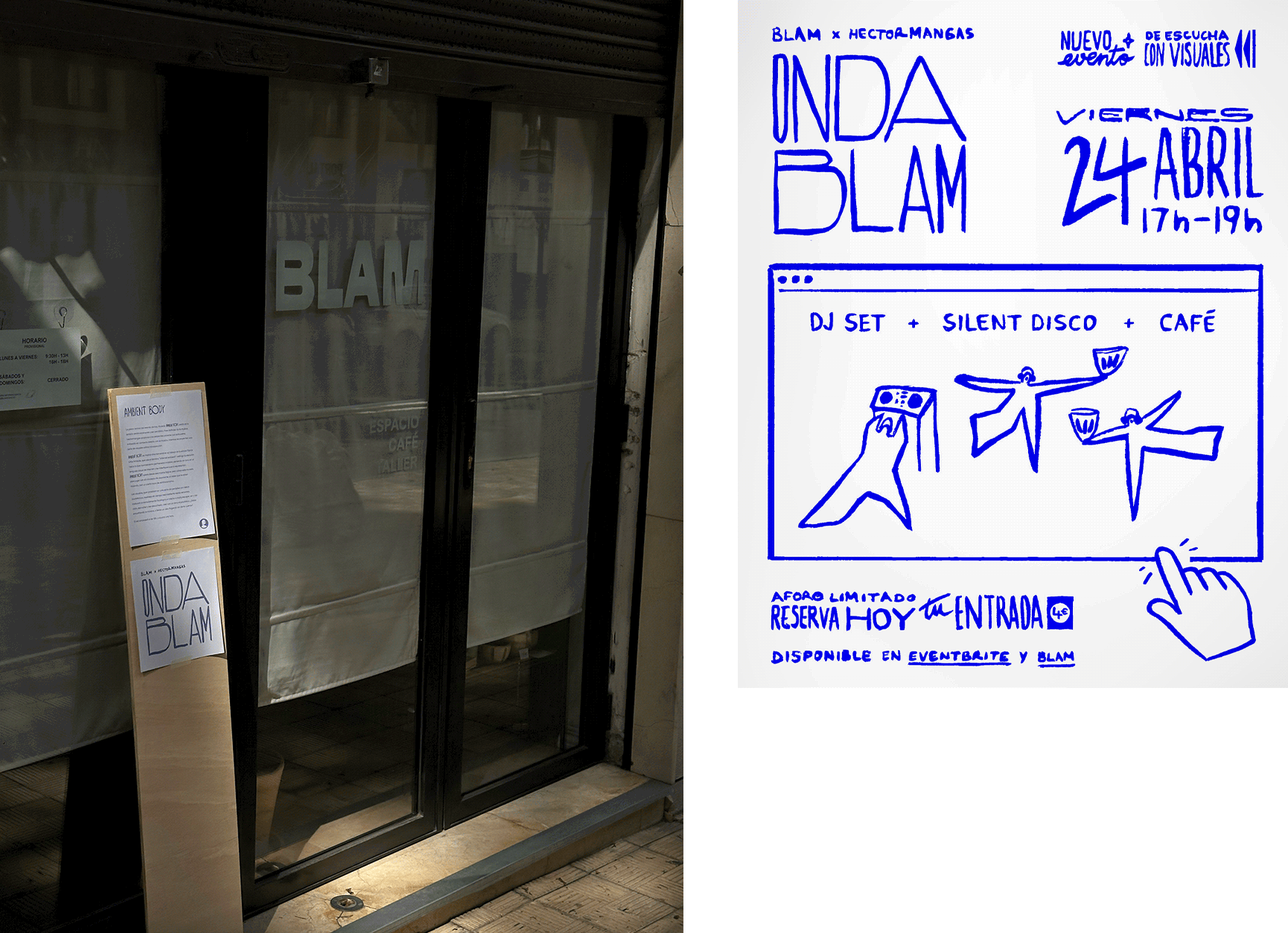
The set was broadcast through a self-hosted audio stream, over a dedicated local Wi-Fi network. I developed a simple front end for people to connect from their own devices, which they were encouraged to bring with enough battery. This front end was intentionally made to feel like an intimate connection with the piece, where the song that was playing would show as "Héctor ha puesto X" (Héctor is playing X) in people's devices.
I stood there, manipulating the machine, with a room full of attentive ears paying attention to my output and scrutinising it carefully. At times, the set felt closer to a tech demo than an installation or listening event. Close-up, intimate shots of someone using a novel technology, showcasing it to a room of curious eyes, where it seemed likely that one little mistake would be amplified, becoming the most memorable point of the evening. Or well, maybe this is just my self-conscious perception of what the event was like.
